
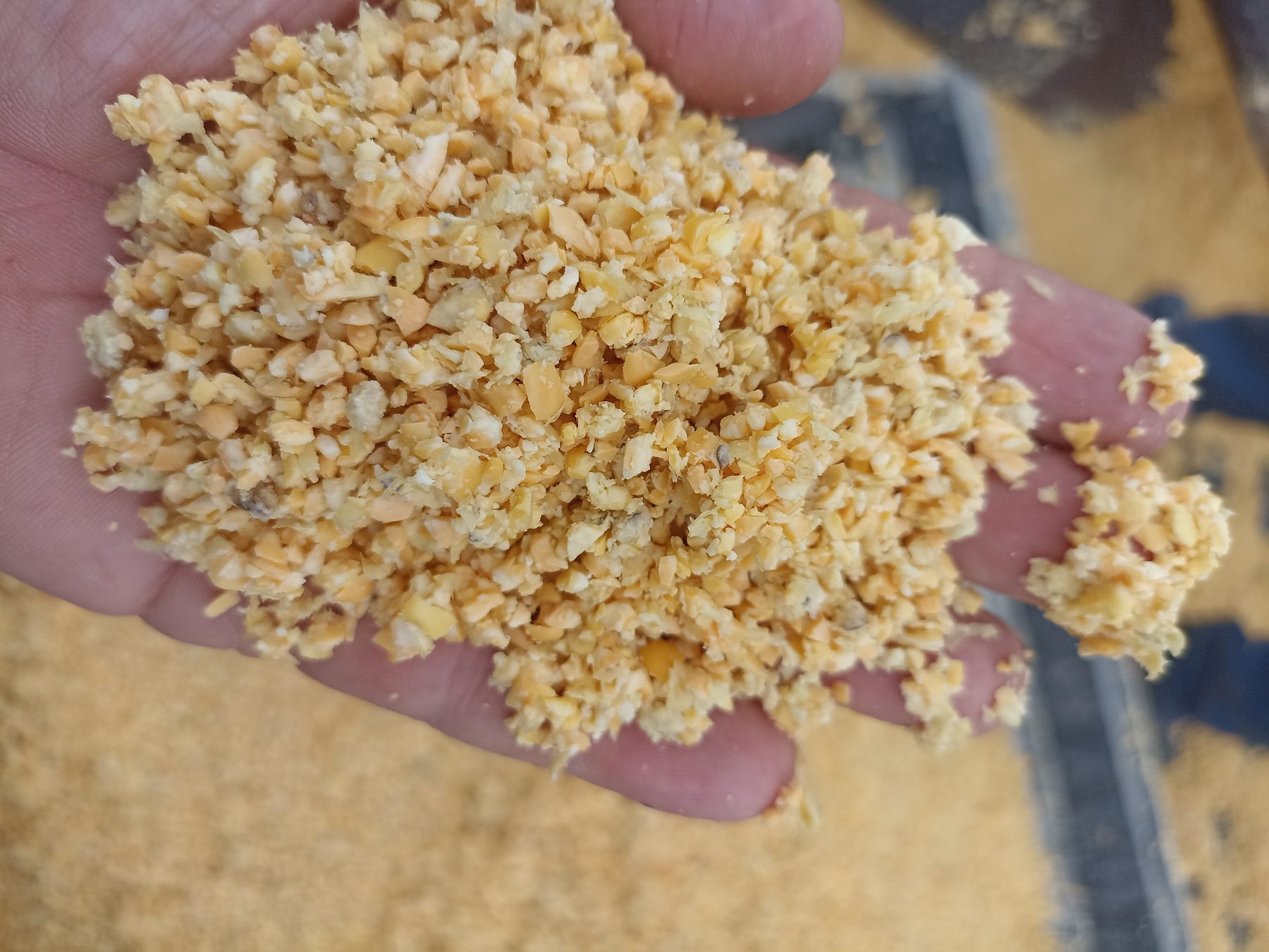
What defines high-moisture corn
The grain is harvested before commercial drying, processed by milling or rolling, and preserved by ensiling. Higher moisture reduces the need for artificial drying and creates conditions for fermentation. During storage, proteolysis can reduce the protein barrier around starch granules and increase starch accessibility. This does not mean that every high-moisture corn will automatically be superior: hybrid, maturity, particle size and preservation quality all affect the response.
Stages that determine the outcome
Operational sequence matters. Harvesting at the planned stage, measuring actual moisture, adjusting rolls or screens, checking particle distribution, excluding oxygen quickly and maintaining the seal are connected decisions. A good process does not end at the machine: temperature, bag or silo integrity and feed-out stability must also be monitored.
Moisture and particle size must be evaluated together
Moisture influences fermentation and preservation; particle size determines contact area and the rate of ruminal fermentation. Very fine particles can increase starch utilization rate and require greater attention to effective fiber and bunk management. Excessively coarse particles can increase passage of undigested starch. This is why MillS uses MPS, particle-size distribution and sieve fractions rather than relying only on visual appearance.
Where high-moisture corn can create value
Economic value may come from lower drying and handling costs, less physical breakage and improved starch utilization. The decision should compare cost per ton of useful dry matter, losses along each route and the effect on intake and performance—not simply the incoming price per ton of corn.
Practical control points
- Measure moisture by batch rather than relying only on harvest date.
- Adjust processing using real samples and sieve analysis.
- Close and seal the storage system quickly.
- Monitor integrity, heating and feed-out stability.
- Integrate fecal starch, performance and cost to confirm the result.
Common questions about this topic
Is high-moisture corn the same as rehydrated corn?
No. In high-moisture corn, the water is already in the grain at harvest; with rehydrated corn, water is added to dry grain before ensiling.
Is there one ideal moisture level?
No. There are reference ranges, but the target depends on the grain, equipment, storage system, climate and nutritional strategy.
Does high-moisture corn always improve performance?
No. The response depends on processing, preservation, diet, management and what it is being compared against.
Related technical basis
Jacovaci et al. (2021), Hoffman et al. (2011), Owens et al. (1997). See the complete references and interpretation limitations in the MillS Technical Center.
The values and ranges cited are technical and operational references. Final recommendations depend on grain, machinery, diet, storage, climate and economic goals.