
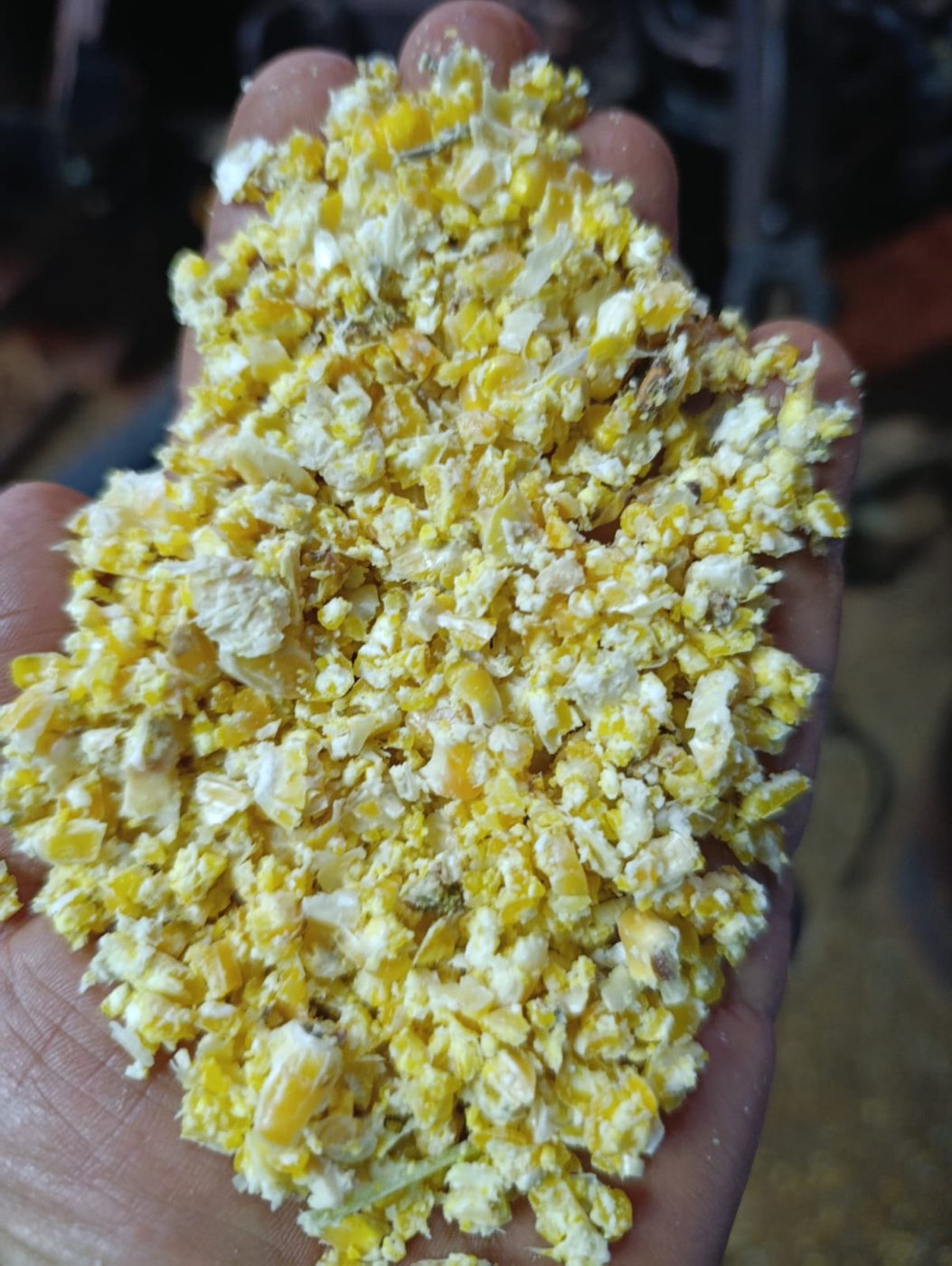
How rehydration works
The process starts with dry grain, which is milled or rolled, receives water until the target moisture is reached, and is then ensiled. The goal is to create an environment that supports fermentation and changes in the protein matrix, improving access to starch. Water must be incorporated uniformly; overly dry zones and waterlogged zones within the same mass lead to different fermentation behavior.
Water calculation must be based on dry matter
Adding a fixed number of liters per ton is incorrect when initial moisture varies. The correct calculation conserves dry matter: measure initial moisture, define the target and calculate the required final mass. Therefore, batches at 14% and 25% moisture require very different amounts of water to reach the same target.
Milling before or after water addition?
The sequence depends on line configuration and mixing capacity. In high-throughput systems, the practical goal is to ensure consistent particle distribution and moisture at discharge. The critical point is preventing water from simply passing through the flow without being incorporated into the processed grain.
Storage time and use
Fermentation changes do not occur instantly. The earlier the material is opened, the less time is available for the transformations associated with ensiling. Opening decisions should consider inventory, stability and nutritional goals; a fixed number of days should not be treated as a universal rule.
Practical control points
- Measure initial moisture immediately before processing.
- Calculate water per ton and convert to L/h and L/s according to machine capacity.
- Check mixture uniformity throughout the shift.
- Control MPS, particle-size distribution and sieve fractions.
- Record bag, batch, operator, throughput and final moisture.
Common questions about this topic
Can very dry corn be rehydrated?
Yes, provided the system can incorporate water uniformly and achieve suitable ensiling conditions.
Does added water increase dry matter?
No. Dry matter remains the same; as-fed mass and moisture percentage increase.
Is rehydration just wetting the corn?
No. It is an integrated process involving milling or rolling, water dosing, mixing, ensiling and storage control.
Related technical basis
Gomes et al. (2020), Hoffman et al. (2011), Jacovaci et al. (2021). See the complete references and interpretation limitations in the MillS Technical Center.
The values and ranges cited are technical and operational references. Final recommendations depend on grain, machinery, diet, storage, climate and economic goals.